
Short answer
Santorini is the rim of a volcano: a crescent of cliffs around a flooded caldera, with Fira, Imerovigli and Oia along the top. Stay on the caldera for the view, or in Pyrgos, Kamari or Perissa for more space for your money. Give the island three to four days, and spend at least one of them on the water, where the hot springs, Red Beach and White Beach are.
- Days to give it
- 3–4
- Best months
- Late May–June, September
- Arrive at
- Santorini airport or Athinios port
- Must-do
- A day on the caldera by boat
Santorini is small, under 20 kilometres from end to end, but it packs in more than most Greek islands: cliff-top villages, a volcano you can swim beside, Bronze Age ruins, black-sand beaches and some of the best white wine in the country. We are a Santorini yachting company at Vlychada Marina on the south coast, and this is the island as we would explain it to a friend on their first visit.
Santorini in short
Santorini is what remains of a volcano. About 3,600 years ago a huge eruption, known as the Minoan eruption, emptied the magma chamber under the island and the centre collapsed into the sea. What is left is a ring of land around a flooded caldera up to about 400 metres deep.
- The west side is the caldera: cliffs up to 300 metres high, with Fira, Firostefani, Imerovigli and Oia along the top.
- The east and south slope gently down to the sea, with the black-sand beaches of Kamari and Perissa and the villages of Pyrgos, Megalochori and Emporio inland.
- In the middle of the caldera are Nea Kameni and Palea Kameni, two young volcanic islets, and the hot springs.
- Across the caldera is Thirasia, a small island with a few villages and very few visitors.
Most of what you will remember about Santorini is either looking out over the caldera or being on it.

Which village to stay in
Where you stay shapes your trip more than anything else. The caldera villages have the view and the price that comes with it; the villages inland and by the beach give you more space for your money.
| Village | Best for | What it is like |
|---|---|---|
| Fira | First visits, getting around | The main town, busy and central; every bus starts here |
| Firostefani | Caldera view, a short walk to Fira | Quieter than Fira, ten minutes away on foot |
| Imerovigli | Honeymoons, sunsets | The highest caldera village, calm, with the Skaros rock below |
| Oia | The classic view | Beautiful and crowded at sunset; the most expensive rooms |
| Pyrgos | A quieter village | Inland, on a hill, with lanes around an old castle |
| Megalochori | Wine and quiet | A small village among vineyards, close to the caldera |
| Kamari | Beach and families | Black-sand beach with a long promenade of tavernas |
| Perissa and Perivolos | Beach and lower prices | A long black-sand beach with beach bars |
If you are not sure, split your stay: a couple of nights on the caldera for the view and the rest by the beach or in a village inland.
Getting there and getting around
- By air: Santorini airport has flights from Athens all year, under an hour, and direct flights from many European cities from spring to autumn.
- By ferry: boats arrive at Athinios port, below the cliffs south of Fira. Fast ferries from Piraeus take about 5 hours, conventional ones 7 to 8. There are ferries to Mykonos, Naxos, Paros and Ios in season.
- Buses: the public buses leave from the bus station in Fira for Oia, Kamari, Perissa, Akrotiri, Vlychada, the airport and the port. They cost a few euros a ride and run often, but are full in July and August.
- Taxis: there are not many, and in summer the queue in Fira and Oia after sunset can be long. Book transfers ahead.
- Car or quad: the easiest way to see the south and the wineries. Parking in Oia and Fira is very limited in summer.
- The old port of Fira: a cable car and a path of about 600 steps link Fira with the old port, where the boats to the volcano leave.
What to see
The caldera walk from Fira to Oia
The path along the caldera rim runs about 10 kilometres from Fira through Firostefani and Imerovigli to Oia. It takes three to four hours at an easy pace, with almost no shade after Imerovigli. Start early in summer, take water, and wear proper shoes: parts of the path are loose gravel.
Oia
Oia, on the northern tip, is the village on the postcards, with blue domes and windmills above the sea. It is at its best in the morning, before the day visitors arrive. At sunset the castle and the lanes around it fill an hour or more before the sun goes down; Imerovigli, the Akrotiri lighthouse or the deck of a boat are calmer places to watch it. The sunset time changes a lot through the year: see Santorini sunset time for today’s.
Akrotiri and the museums
The Bronze Age town of Akrotiri, buried by the eruption and preserved under the ash, is the most important ancient site on the island. You walk on raised paths above streets and two-storey houses, under a roof that protects the whole site. Entry is €20 in summer 2026, and the Museum of Prehistoric Thera in Fira, which holds its wall paintings and pottery, is €10. Opening hours change through the season; check the Ministry of Culture’s page before you go.
High above Kamari, Ancient Thera is a later Greek and Roman town on the top of the Mesa Vouno mountain, reached by a steep road and a short walk. The view over both coasts is worth the climb.
Pyrgos and Profitis Ilias
Pyrgos is the best-preserved inland village, with lanes winding up to the ruins of a Venetian castle. Above it, Profitis Ilias is the highest point of the island, at 567 metres, with a monastery and a view over the whole of Santorini.
The beaches, in brief
Santorini’s beaches are volcanic, not golden. Kamari and Perissa have long stretches of black sand with sunbeds and calm water; Red Beach and White Beach, on the south coast, are for looking at and swimming off a boat rather than lying on. The full list is in our guide to the best beaches in Santorini.
Santorini from the sea
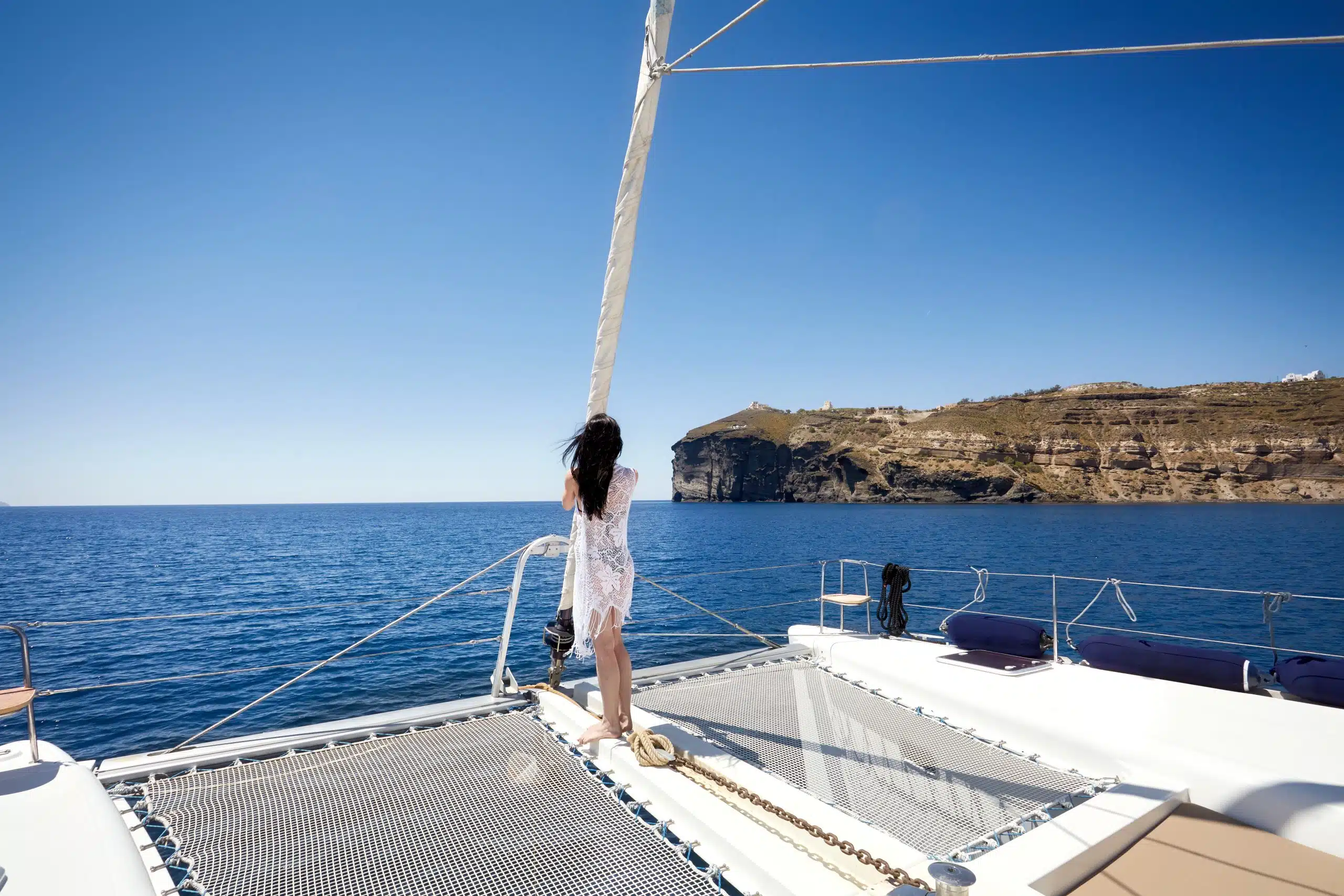
The caldera only makes full sense from the water. From a boat you see the cliffs from below, the layers of ash and lava in the rock and the villages along the top. You also reach the places that have no road: the volcano hot springs, White Beach and the coves of the south coast.
All our boat tours leave from Vlychada Marina, with hotel pickup included. Our semi-private catamaran cruises take up to 20 guests, with a BBQ cooked on board, and run as a 10:00 day cruise or a 15:00 sunset cruise. For a honeymoon, a family or a group of friends, a private catamaran or motor yacht keeps the boat, the route and the timing to yourselves.
Food and wine
The volcanic soil and the dry summers give Santorini’s produce a strong, concentrated taste. Look for these on the menu:
- Cherry tomatoes: small, sweet and grown without watering. Tomatokeftedes, fried tomato fritters, are on almost every taverna menu.
- Fava: a purée of yellow split peas, served warm with onion, capers and olive oil.
- White aubergine: milder and sweeter than the purple kind.
- Capers and caper leaves: picked wild and used in salads.
- Assyrtiko: the island’s dry white wine, crisp and mineral. It goes with everything from grilled fish to the BBQ on our boats.
- Vinsanto: a sweet amber wine made from grapes dried in the sun.
The vines are trained low into round baskets, called kouloura, to protect the grapes from the wind. Many of the wineries around Pyrgos, Megalochori and Exo Gonia offer tastings; book ahead in summer.

When to go
Late May to June and September to early October are the best months: the sea is warm, it hardly rains and the island is calmer than in July and August. April and late October are good for walking. Most hotels and many restaurants close from November to March. Our guide to the best time to visit Santorini goes through it month by month.
Practical tips
- Book early for June to September, especially rooms with a caldera view and sunset cruises.
- Avoid Fira and Oia at midday on days when several cruise ships are in; go early or late.
- Wear flat shoes. The lanes are steep, uneven and slippery when polished by feet.
- Drink bottled water. Tap water is desalinated and not for drinking.
- Set your watch. Santorini is on Greek time, an hour ahead of Paris and two ahead of London; here is the time in Santorini now.
- Carry some cash for small tavernas, buses and tips; our guide to tipping in Santorini has the usual amounts.
Is Santorini worth it?
Yes, if you come for what makes it different: the caldera, the light, the villages on the cliff and the sea around the volcano. Nothing else in Greece looks like it. It is less worth it if you want long sandy beaches (see Mykonos vs Santorini), quiet evenings in July and August, or a holiday where the price does not matter, because the island is busy and the best views cost money.
Our honest advice: come in June or September, stay at least three nights, sleep on the caldera at least once, and spend one day on the water. That combination is what makes guests come back.